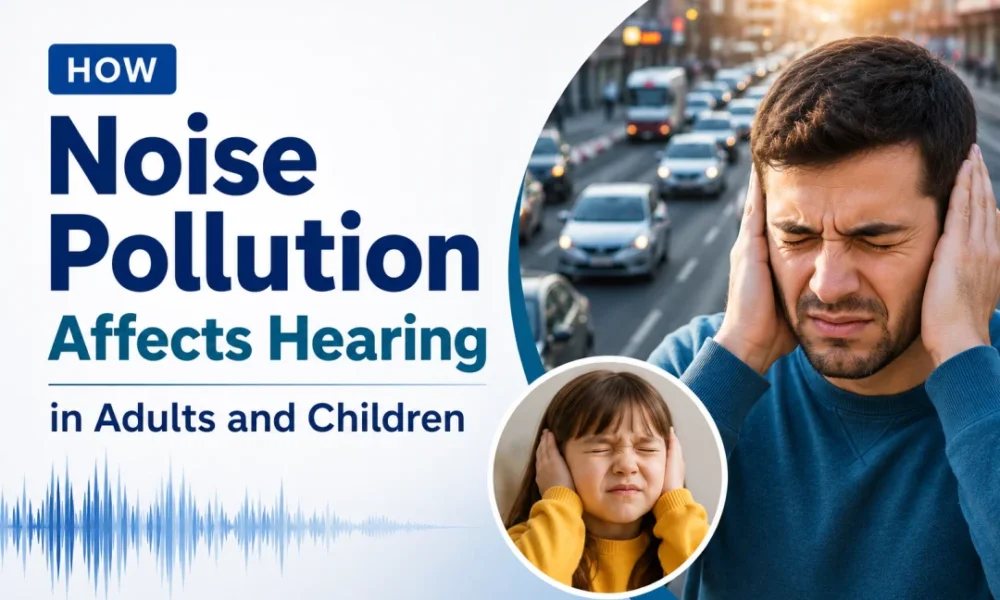
What if the sounds you hear every day are quietly damaging your hearing? Most people believe that hearing issues come with aging. However, hearing experts now see increasing cases linked to daily noise exposure. From traffic and construction work to headphones and crowded public spaces – excessive sound can affect hearing long before symptoms become obvious.
The effects are no longer limited to adults. Children are also at risk – especially during key stages of learning and development. Once families understand the impact of noise on hearing – they can take the right steps to protect their ears in the long term.
What is Noise Pollution?
Any unwanted or excessive sound that interferes with daily normal activities and overall well-being. While occasional loud sounds may not cause lasting harm – repeated exposure can become a serious concern.
Common sources of noise pollution include:
- Heavy traffic, vehicle horns, railways, and airports – these create constant background noise in urban areas.
- Construction sites, industrial equipment, and factory machinery often operate at high decibel levels.
- Loud concerts, movies, and entertainment venues – sound levels here often exceed safe hearing limits.
- Headphones and earbuds on high volume for long periods.
Long-term exposure to sounds above safe levels can gradually increase the risk of hearing damage – even when discomfort is not immediately noticeable.
How Excessive Noise Damages Hearing
Our ability to hear actually relies on thousands of microscopic hair cells deep inside the inner ear. Think of them as tiny biological translators – they take passing sound waves and instantly flip them into electrical signals our brains can actually make sense of.
When exposed to loud noise several things can happen:
- Hair cells become overstimulated and temporarily lose sensitivity – causing muffled hearing after a noisy event.
- Repeated exposure places ongoing stress on these delicate structures.
- Damaged hair cells cannot repair or regenerate naturally.
- Permanent hearing problems may develop when a large number of cells are destroyed over time.
A common myth is that hearing loss only happens due to exposure to high sounds. But the truth is moderate noise exposure over many years can also contribute to permanent hearing problems.
Impact on Adults
A major problem that adults face is constant noise exposure from multiple sources throughout the day. Be it workplace environments or recreational activities – all these lead to cumulative hearing stress.
Common effects are:
- Increased risk of hearing loss among workers exposed to machinery or industrial equipment.
- Difficulty concentrating in noisy offices and public environments.
- Reduced productivity due to mental fatigue caused by continuous background noise.
- Poor sleep quality – particularly for people living near busy roads or transport hubs.
- Higher stress levels – which may affect overall physical and mental well-being.
Audiologists in Houston also believe that chronic environmental noise exposure affects quality of life – making hearing protection important even outside the workplace.
Impact on Children
Because a kid’s hearing system is still developing – loud noises can do a lot more damage early on.Heavy noise exposure can throw a wrench into how they hear, learn, and absorb information.
Common effects are:
- Difficulty understanding speech in classrooms with high background noise.
- Reduced attention span and lower ability to focus during lessons.
- Challenges in reading and communication development.
- Lower academic performance when important information is missed.
- Increased listening effort – which can lead to fatigue throughout the school day.
Even low-level environmental noise can affect learning when exposure occurs regularly. This is why education and hearing experts always prefer quiet learning spaces. Reducing distractions makes it easier for kids to absorb information.
Early Signs of Hearing Damage
Hearing loss never happens all at once. It happens so slowly that most people have no idea there’s even a problem – until they find themselves struggling to keep up with a normal conversation.
These are the common warning signs:
- You notice a constant ringing or buzzing sensation in your ears – a condition known as tinnitus.
- It feels like a massive chore to understand what people are saying in noisy rooms or crowded social settings.
- Frequently having to ask others to repeat themselves.
- Realizing you need the TV or headphone volume much higher than you used to.
- It constantly feels like people are whispering or that their words are just unclear.
If you recognize these early signs – it can make a huge difference in conserving your hearing health and receiving the appropriate support before it deteriorates further.
Preventive Measures for Families
The silver lining here is that noise-related hearing loss is almost entirely preventable. You just need to add a few simple, protective habits in your family’s daily routine – and that’s it.
Smarter habits to follow:
- It’s best to keep headphone volume under 60 level – and take a break after 60 minutes.
- Pop a pair of earplugs or earmuffs into your bag. They’re lifesavers at loud concerts or when you’re using noisy power tools.
- Make it a point to unplug your earbuds completely a few times a day.
- Don’t forget about the kids’ toys – some of those high-decibel entertainment systems get shockingly loud.
- Your ears actually need time to recover – so try scheduling a bit of quiet time in your afternoon routine.
When to Get a Professional Hearing Evaluation
Hearing conditions respond better when detected early. However, people often delay testing – because symptoms seem minor at first.
Take a hearing test if:
- Ringing in the ears lasts for several days or longer.
- Conversations become difficult to understand.
- A child frequently misunderstands instructions or asks for repetition.
- There is regular exposure to loud workplaces, music, or recreational activities.
- Family members notice hearing changes before the individual does.
A thorough hearing assessment can identify problems early and help prevent further progression through proper management.
Final Words
Noise pollution isn’t just annoying – it damages your health over time. But you can stop it. By spotting early warning signs, lowering your volume, and seeing audiologist in Sugarland if needed – you and your kids can easily protect long-term hearing health.